Most operations and procurement teams evaluate frying oil on one metric: cost per litre. It’s the obvious number, the one that fits neatly into a purchase order.
The figure that actually drives your bottom line is how long the oil performs before it needs replacing.
“All frying oils deteriorate under heat. The difference is how quickly that deterioration happens.”
Because every changeover costs you more than the oil itself – it costs you service time, labour, consistency, and the kind of product quality variation that shows up in customer complaints before it shows up on a cost report.
This is the gap CERTIO® was engineered to close.
Why Oil Stability Matters
All frying oils deteriorate when exposed to heat. One of the key ways the industry measures this breakdown is through Free Fatty Acid (FFA) content, which indicates how fresh and stable the oil is. As FFA levels increase, the oil becomes less stable, darkens faster, turns rancid more easily, and requires more frequent replacement.
Standard commercial palm olein specifications typically enter operations with FFA levels at 0.1% maximum. That’s within an acceptable commercial range, but under continuous high-temperature frying, it accelerates degradation meaningfully.
“CERTIO® is refined to a maximum FFA of 0.05% as a start, up to two times lower than standard commercial palm olein specification.”
The oil starts fresher, holds its performance for longer, and maintains quality consistency across more frying cycles. That’s not a marginal improvement in a high-volume setting; it compounds across every shift.
The Data That Matters: Colour & Total Polar Matter (TPM)
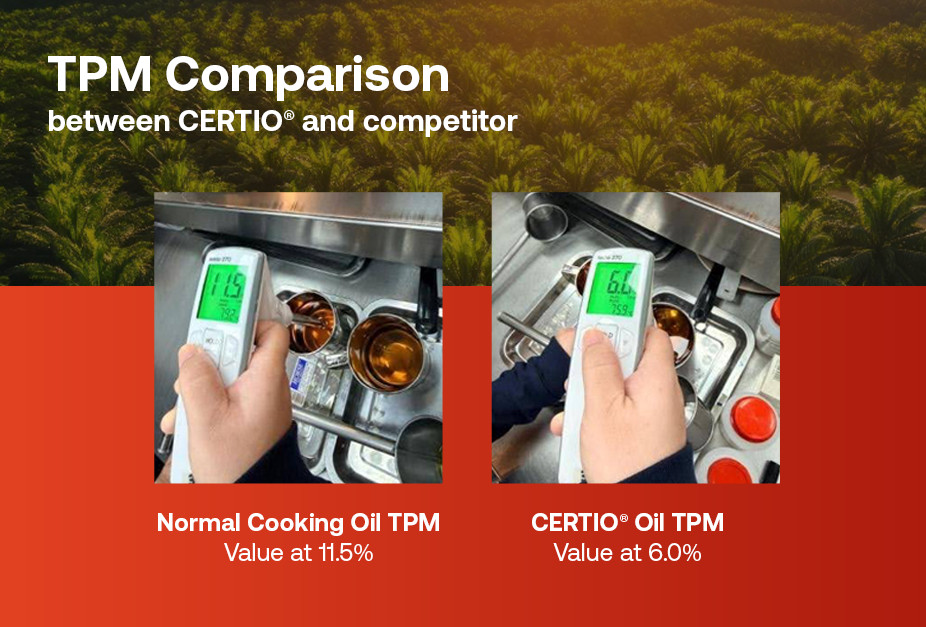
Two measures matter most to commercial operators and quality managers: Total Polar Matter (TPM) and colour stability.
TPM is a global regulatory benchmark for frying oil safety. It refers to the compounds that build up as frying oil breaks down under repeated heat, oxygen exposure, moisture and food contact. As TPM rises, it becomes a clearer signal that the oil is moving closer to the end of its usable life.
TPM can influence food safety, taste, colour, texture and oil absorption which is why many foodservice operations use TPM readings to decide when oil should be changed.
The globaL market discard standard for TPM sits at 25%, requiring oil to be discarded once it exceeds that level. An oil with a lower starting TPM and a slower accumulation rate reaches that threshold later, giving operators longer frying cycles before changeover.
CERTIO® demonstrates a slower TPM accumulation rate than conventional cooking oils across multiple frying cycles. This helps the oil remain within safer limit while providing longer frying life.
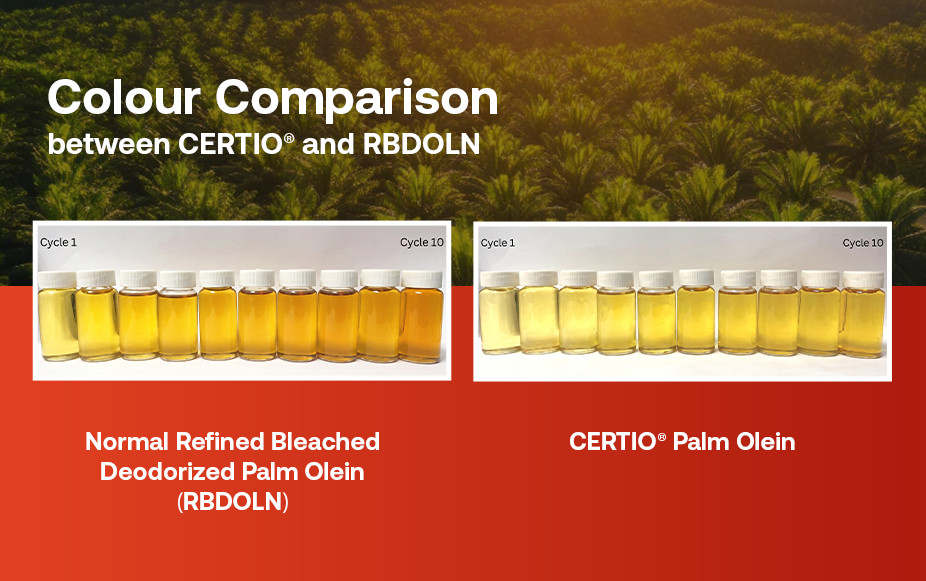
The second measure, that is colour stability, follows the same principle. CERTIO®’s slower degradation rate helps the oil maintain a lighter colour across more cycles, giving operators a practical visual cue that supports what the chemistry is already indicating.
What It Means for Changeover Frequency
Independent trials show CERTIO® reduces oil changeover frequency by a minimum of 20% compared to standard palm olein.
For a high-volume Quick Service Restaurant (QSR) chain running multiple fryers per site, or a food manufacturer producing at scale, this translates directly into fewer operational changeover interruptions, lower total oil consumption and more predictable production output.
The savings go beyond the oil itself. Every changeover takes man-hours to drain, clean, refill and restart the fryer, while also adding to utility usage during temperature recovery. Fewer changeovers also mean less frequent handling of hot used oil, reducing exposure to workplace safety risks during daily operations.
For operators, this means stronger control over both visible and hidden frying costs, while maintaining a more consistent output across service or production cycles.
Built for Different Frying Needs
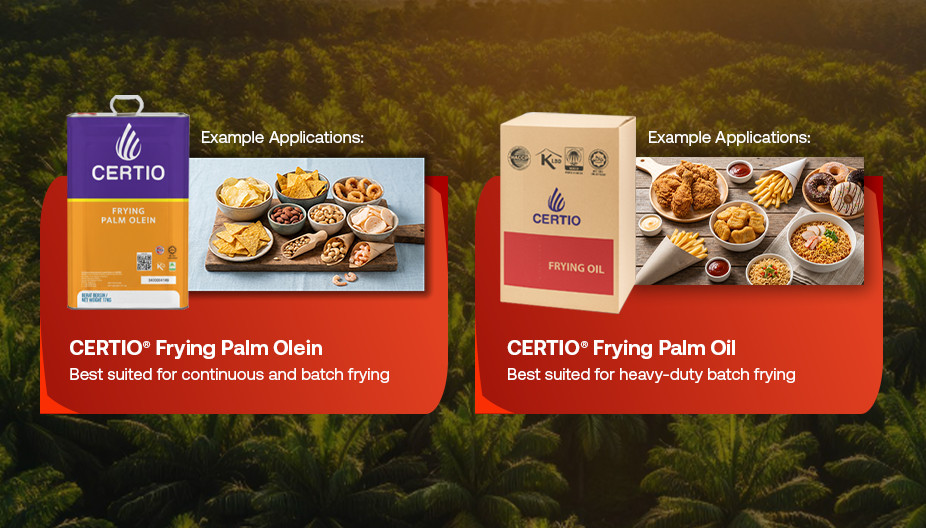
CERTIO® Frying Oil is a semi-solid, pourable form, designed for heavy-duty batch frying where oil absorption and texture is the primary quality variable. The applications are fried chicken, nuggets, fries, doughnuts, and instant noodles. This variant is built for extended frying life under continuous high-temperature conditions.
CERTIO® Frying Palm Olein is the liquid fraction of palm oil, refined for continuous frying. The applications here are high-heat, high-volume: Chips, snacks, nuts, and seafood – applications where the difference between crisp and greasy is the difference between a repeat customer and a complaint.
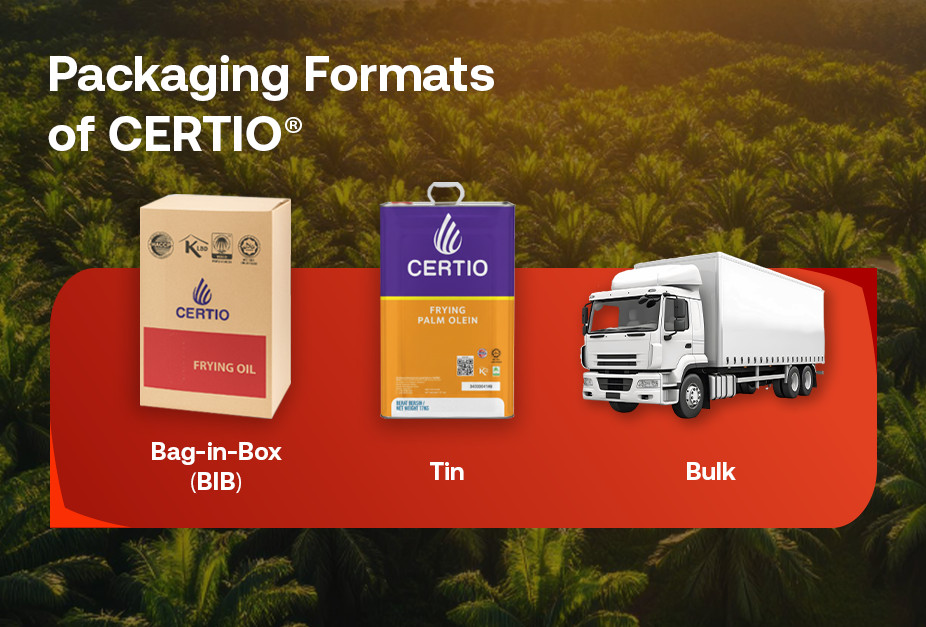
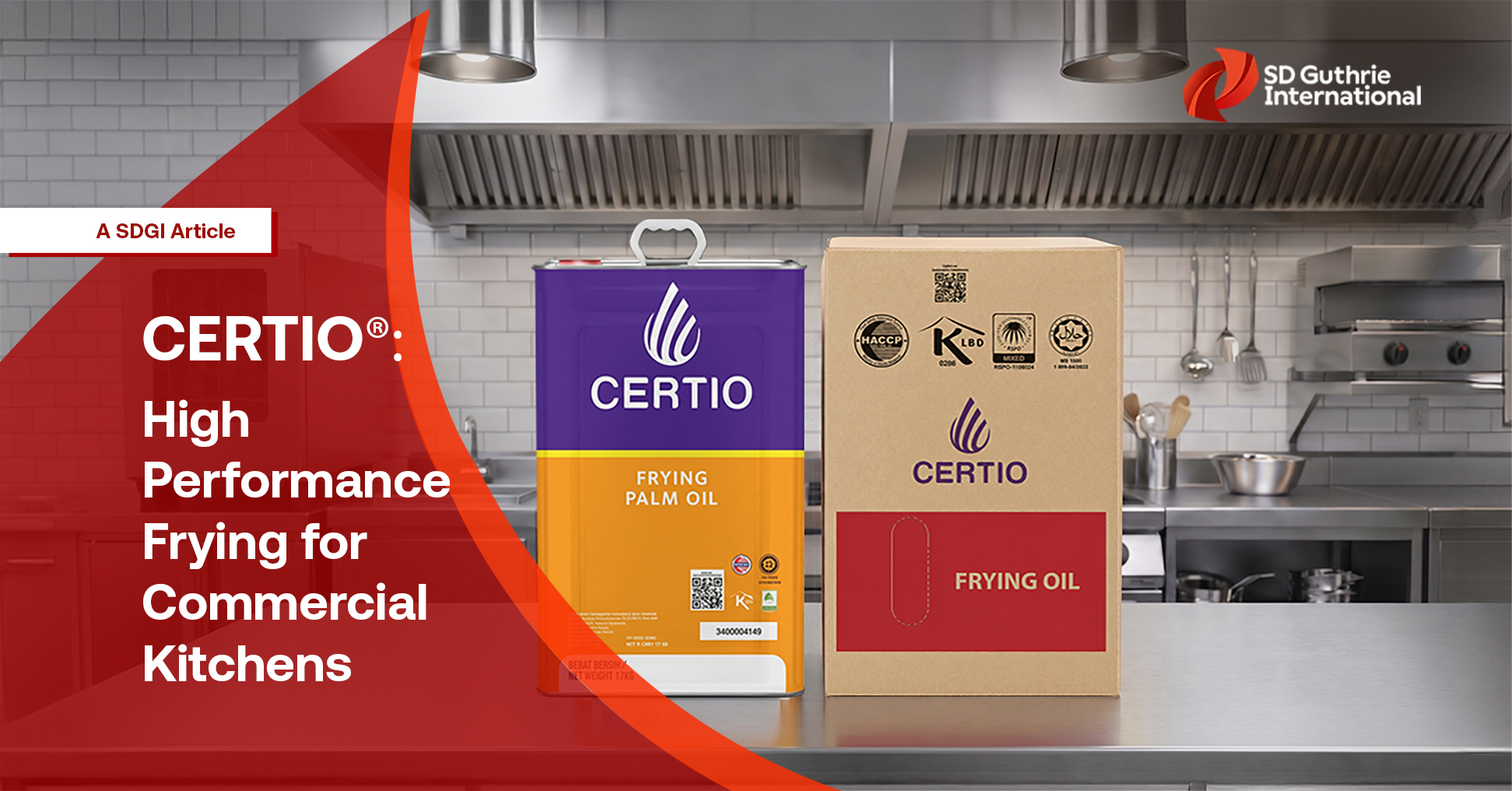
Available in 17kg Bag-in-Box, 17kg tin, and bulk formats – drums, Intermediate Bulk Container (IBC), and tankers – for operations at every scale.
Consistency Starts Before the Refinery
FFA development in palm oil doesn’t begin at the refinery. It begins the moment the fruit is harvested. The longer the interval between harvest and processing, the higher the FFA content in the crude palm oil before it even enters the refinery – a variable that most commodity supply chains cannot control because they don’t own the chain.
SD Guthrie does.
CERTIO® is produced from Crude Palm Oil grown, harvested, milled, and refined within SD Guthrie’s fully integrated estate-to-refinery network. That vertical integration removes the freshness variable at the source. HACCP-certified mills, tightly controlled refining conditions, and consistent quality checks at every stage ensure that each batch meets the same specification.
For procurement and R&D teams managing multi-market compliance, CERTIO® carries Halal, RSPO, HACCP, and Kosher certification – a stack that reduces supplier qualification complexity significantly across Southeast Asia, the Middle East, United States and European markets.
What It Looks Like in Practice
Encik Fazly manufactures chips in Selangor. After switching to CERTIO® Frying Palm Olein, his production line delivers consistently crisp, lower-oil-absorption chips with fewer changeovers per shift. For him, the result is straightforward: less oil purchased per production run, more predictable output quality, and a reduction in the kind of batch-to-batch variation that chips manufacturers cannot afford to explain to retailers.
“I used to get about 6 frying cycles with regular frying oil. Then I switched to CERTIO®, and now I can fry up to 9 cycles. My food is crispier, less greasy, and the original flavour tastes better.”
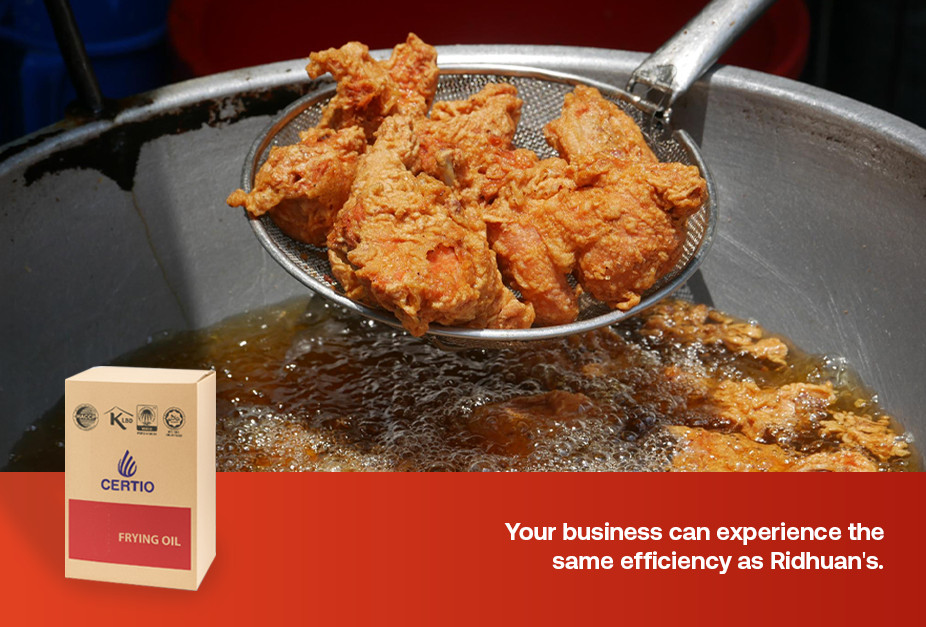
Encik Ridhuan, who operates a fried chicken chain, saw stronger frying control after switching to CERTIO®. With a more stable degradation profile, oil inconsistencies were reduced across his kitchens, from fryers darkening at different rates to variable product texture during service. His team also needed less frequent intervention to manage oil conditions, resulting in fewer changeovers, more consistent product quality and less disruption during peak hours.
Across both chips manufacturing and fried chicken foodservice, the improvement came down to better control over oil degradation, helping reduce variability in environments where product quality, output and customer experience depend on consistency.
Sustainable by Design. Certified to Prove It.
CERTIO® is produced by SD Guthrie International, one of the world’s largest producers of Certified Sustainable Palm Oil (CSPO), contributing approximately 12% of global CSPO output. SD Guthrie is ranked #1 on the SPOTT ESG transparency assessment and #80 on the Fortune SEA500 – the global benchmark for responsible palm oil production.
For ingredient buyers and procurement teams facing growing compliance pressure under frameworks such as the EU Deforestation Regulation (EUDR), the sustainability credentials carry the same weight as the performance data. Full supply chain traceability, deforestation-free sourcing, and verified certification aren’t marketing additions to CERTIO® – they’re built into the same integrated supply chain that produces the 0.05% FFA specification.
High performance and responsible sourcing are not a trade-off here. Both are engineered in.